

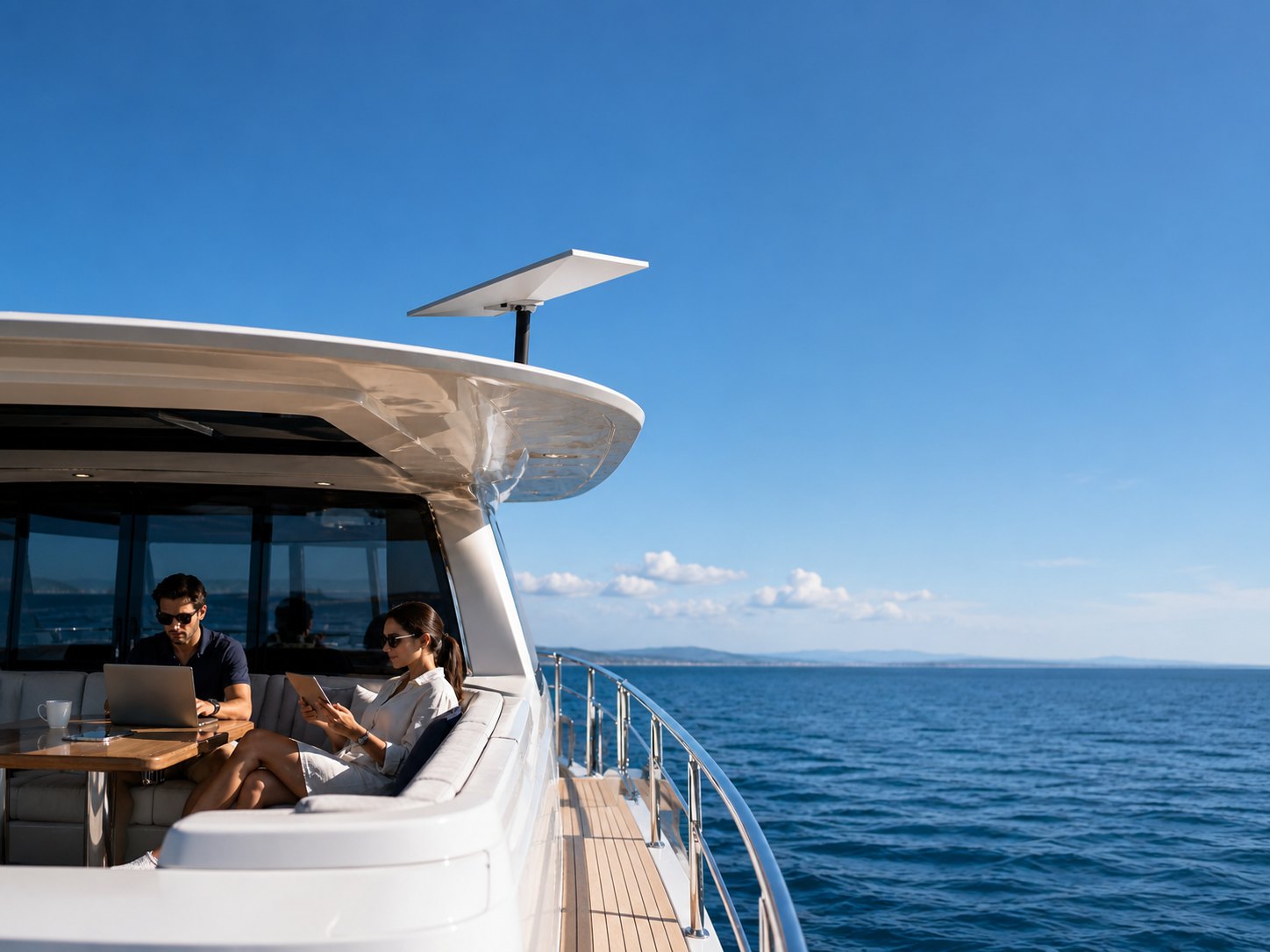
Build a safer and more practical Starlink installation with compatible mounting, power and cable solutions for boats, yachts and marine service projects.
A marine Starlink setup must address more than basic hardware compatibility. The installation also needs a clear view of the sky, stable power, secure mounting, protected cable routing and materials suitable for the intended operating environment.
YIZHOU supplies independent third-party accessories compatible with selected Starlink Mini and Standard models. We support boat owners, marine electronics installers, yacht service companies and distributors looking for portable, removable or fixed accessory configurations.
Tell us your Starlink model, vessel type and intended use. We can help you identify suitable mounting and power accessory options for further evaluation.
Get a Marine Solution Recommendation
What Makes a Marine Starlink Installation Different?
Equipment installed on a boat may be exposed to vibration, movement, salt, moisture, ultraviolet light and changing wind conditions. These factors affect the mount, fasteners, cables, connectors and power system.
A complete marine installation plan should consider:
- The exact Starlink hardware model
- Stationary or in-motion operation
- Vessel size and mounting location
- Available AC, 12 V or 24 V power
- Obstructions from masts, radar equipment and other structures
- Exposure to salt spray and standing water
- Cable routing and connector protection
- Removal, storage and maintenance requirements
- Applicable Starlink service plan and regional rules
Hardware compatibility and service availability are separate decisions. A mount may fit the terminal, but the Starlink hardware and service plan must also support the intended location and operating mode.
Choosing a Starlink Model for Boat Use
Starlink Mini for Portable and Small-Vessel Setups
Starlink Mini can be a practical option for smaller boats, occasional trips and removable installations. Its compact format, built-in Wi-Fi router and DC input make it easier to integrate into a portable accessory kit.
Compatible accessory categories may include:
- Portable battery stands
- Clip-on battery packs
- Quick-release mounting bases
- Pole or railing adapters
- Compatible DC power cables
- Protective covers
- Carrying and storage cases
According to the official specifications, Starlink Mini accepts 12–48 V DC input, has a maximum input rating of 60 W and an average stated power consumption of 25–40 W. These figures are useful when reviewing a vessel’s battery and charging system.
The official environmental rating applies to the Starlink Mini terminal when the specified cable and connector are properly installed. It does not automatically apply to a third-party mount, battery, cable or other accessory. Each component should be evaluated separately.
Starlink Standard for Larger or Fixed Installations
Starlink Standard may suit boats with more installation space and sufficient onboard power. It can be considered for hardtop, pole or other fixed and semi-permanent installations.
Accessory requirements may include:
- A model-specific mounting base
- Quick-release hardware
- Pole, rail or hardtop mounting components
- Secure power-supply mounting
- Cable-routing and strain-relief components
- A suitable AC or DC power configuration
Starlink Standard has different dimensions, mounting interfaces and power requirements from Starlink Mini. Always confirm the exact hardware generation before selecting an accessory.
Starlink Performance for Professional Maritime Applications
Starlink recommends its Performance hardware for demanding maritime environments and commercial vessel applications. These projects may require more specialized mounting, networking, power and installation support.
YIZHOU accessory compatibility should be confirmed individually for these systems. We do not recommend substituting a Mini or Standard accessory when the dimensions, load requirements or mounting interface have not been verified.
Marine Mounting Options
Portable Deck or Dockside Setup
A portable setup may be appropriate for occasional use while the vessel is stationary. The terminal can be deployed in an open location and removed for storage after use.
Possible components include:
- Portable stand or tripod
- Starlink Mini compatible battery
- Quick-release mounting interface
- DC power cable
- Protective carrying case
The equipment must be positioned where it cannot slide, fall over or be exposed to avoidable water accumulation. Portable equipment should be secured whenever vessel movement, wind or wake could affect it.
Rail or Pole Mounting
A rail or pole installation can elevate the terminal above parts of the vessel that may obstruct its view of the sky.
The installer should evaluate:
- Pole or rail diameter
- Structural strength
- Clamp and fastener compatibility
- Terminal orientation
- Cable movement and strain relief
- Access for inspection and removal
The mount should not interfere with navigation lights, radar, antennas, rigging or other safety-critical equipment.
Hardtop or Cabin-Roof Installation
A fixed hardtop installation can provide a cleaner result for larger boats and professionally completed projects.
Planning should include:
- A stable structural mounting area
- Water drainage around the mounting base
- Appropriate sealing of drilled openings
- Cable glands or protected cable entry
- Interior access for fasteners
- Routine inspection and maintenance access
Do not rely only on adhesive strength or surface appearance. The installer must confirm that the underlying structure can support the terminal and mount under the intended operating conditions.
Removable and Quick-Release Mounting
A quick-release system can make it easier to remove the terminal for storage, security or maintenance.
The release mechanism should lock securely and should not loosen under normal vibration. Before operating the vessel, verify that all locking components, fasteners and safety restraints are correctly engaged.
Finding the Right Mounting Location
Starlink requires a wide, unobstructed view of the sky. On a boat, masts, sails, radar equipment, cranes, cabin roofs and other antennas can interrupt that view.
Before drilling or installing a permanent mount:
- Identify several possible mounting locations.
- Check structural suitability and cable-routing access.
- Use the Starlink app to scan for obstructions.
- Consider how the view changes when the vessel turns or moves.
- Check clearance from other onboard equipment.
- Confirm that the terminal remains accessible for inspection.
Starlink’s current boat-installation guidance recommends an unobstructed view of the sky and notes that elevated mounting may be necessary around marinas or other obstruction-heavy environments.
Power Options for Marine Starlink Installations
12 V or 24 V DC Power
Many small boats and yachts use 12 V or 24 V battery systems. Starlink Mini can accept DC input within its specified range, but the complete power path must still be checked.
Review the following before installation:
- Battery-system voltage
- Maximum current demand
- Converter or adapter output
- Connector type and polarity
- Cable length and wire size
- Fuse and circuit protection
- Voltage drop under load
A connector that physically fits is not proof of electrical compatibility. Confirm voltage, current, polarity and power protocol before connecting the terminal.
AC Power Through the Original Power Supply
Boats with a stable AC system may use the original Starlink power supply. The power source should be protected from voltage fluctuations and installed in a location appropriate for the power supply’s environmental rating.
The router and power supply should not be placed in an exposed area merely because the outdoor terminal has a weather-resistance rating.
Portable Battery Power
A portable battery can support temporary deployment, small-boat use and situations where the terminal is positioned away from the main electrical system.
Actual operating time depends on usable battery capacity, terminal power demand, cable losses, temperature and other connected equipment. Published battery capacity should not be presented as a guaranteed operating time.
Solar-Assisted Charging
Solar panels can help recharge a portable battery or support a vessel’s existing battery system. Solar performance varies with panel size, sunlight, shading, temperature, installation angle and charge-controller efficiency.
Solar should therefore be designed as part of the full charging system rather than treated as a guaranteed direct power source.
Salt, Moisture and Corrosion Considerations
A product described as suitable for outdoor use is not automatically suitable for long-term marine exposure. Buyers and installers should request information about materials, coatings, fasteners and available environmental test documentation.
Important areas to review include:
- Fastener and bracket materials
- Contact between dissimilar metals
- Paint, anodizing or protective coating
- Drainage around the mounting base
- Connector and cable-entry protection
- Exposure of batteries and power electronics
- Cleaning and inspection requirements
Do not describe a third-party accessory as “marine-grade,” “saltwater-proof” or “corrosion-proof” unless the relevant material specification or test evidence is available for that exact product.
Stationary and In-Motion Use
Starlink service authorization, hardware approval and mount safety must all be checked separately for in-motion use.
An eligible service plan does not prove that a particular third-party mount is mechanically suitable for operation while the vessel is moving. The terminal must be installed with hardware designed for the intended load and operating conditions.
Before using Starlink while underway, verify:
- The exact Starlink hardware model
- Current Starlink service-plan terms
- Regional and territorial-water availability
- The mount’s intended operating conditions
- Structural installation quality
- Fastener locking and safety restraints
- Vessel-specific regulations
Starlink service terms and regional permissions may change. Check the current Starlink account, coverage information and official support guidance before each deployment region.
Example Marine Accessory Configurations
Portable Starlink Mini Boat Kit
Suitable for occasional and stationary use on smaller vessels:
- Starlink Mini compatible portable battery
- Portable stand or removable mount
- Compatible DC cable
- Protective cover
- Carrying case
Removable Rail or Pole Kit
Suitable for installations that require easier removal and storage:
- Model-specific terminal adapter
- Rail or pole mounting hardware
- Quick-release base
- Cable strain relief
- Compatible power adapter
Fixed Starlink Standard Boat Kit
Suitable for professional hardtop or cabin-roof installations:
- Model-specific mounting base
- Structural mounting hardware
- Protected cable entry
- Secure power-supply installation
- Compatible AC or DC power solution
These are example configurations, not universal kits. Final selection depends on the Starlink model, vessel structure, electrical system and intended operating environment.
Information We Need to Recommend a Solution
Please provide the following information with your inquiry:
- Starlink model or a clear photo of the terminal
- Boat or vessel type
- Mounting location
- Portable, removable or fixed installation
- Stationary or in-motion use
- Available AC, 12 V or 24 V power
- Coastal, inland-waterway or ocean use
- Required quantity
- Destination country
Marine electronics installers and distributors can also request sample pricing, wholesale quotations, packaging information and available product documentation.
Frequently Asked Questions
Can Starlink Mini be used on a boat?
Starlink currently identifies Mini as supported hardware for certain boat and in-motion applications. The installation must still use a suitable mount, compatible power source and eligible service plan for the operating region.
Can Starlink Mini be powered from a 12 V boat battery?
Starlink Mini’s official input range includes 12 V, but the source, cable, connector, polarity, current capacity and voltage drop must all meet its requirements. A qualified installer should review permanent marine electrical connections.
Can I use a suction-cup mount while the boat is moving?
Do not assume that a suction-cup mount is suitable for in-motion use. Use it only within the conditions specified by its manufacturer. Vessel speed, vibration, surface material, contamination and water exposure can affect holding performance.
Does an IP rating mean the complete installation is waterproof?
No. A terminal’s IP rating does not apply to every cable, mount, battery, connector or power supply in the installation. The complete system must be evaluated component by component.
Which Starlink service plan is required for boat use?
The appropriate plan depends on the country, inland or coastal use, distance from shore, in-motion requirements and whether the vessel is used privately or commercially. Check the latest Starlink Roam or Maritime terms before activation.
Do you supply official Starlink products?
No. YIZHOU supplies independent third-party accessories designed for compatibility with selected Starlink hardware. We are not affiliated with or endorsed by Starlink or SpaceX.
Build the Right Starlink Marine Accessory Kit
A successful marine Starlink installation depends on matching the correct terminal, mount, power system and cable arrangement to the vessel.
Send us your Starlink model, vessel type, mounting location and estimated quantity. We can help you review compatible accessory options for portable, removable and fixed installations.
Get a Marine Solution Recommendation
Technical References
- Starlink: How to Install Starlink on Boats
- Starlink Mini Specifications
- Starlink Standard Specifications
- Starlink Ocean Mode Information
Starlink and SpaceX are trademarks of Space Exploration Technologies Corp. YIZHOU is an independent supplier of third-party compatible accessories and is not affiliated with, authorized by or endorsed by Starlink or SpaceX.